
Why we are building Hotdata
The Problem
Over the past decade, data infrastructure prioritized throughput and scale over latency and interactivity, cementing large distributed warehouses as the default.
Today, data platform teams pass queries through layers of services, schedulers, pipelines, and caches to get data ready for serving. Each layer adds overhead that mask underlying problems. That model worked fine for the “big data” era, but agents are changing how we think about data access.
Fortunately, many of the techniques created to handle petabyte-scale systems work incredibly well when optimized for smaller datasets (<100GB). Processing tens of millions of rows is now possible in under 10ms.
As hardware has improved, a single machine can process more than before. Vectorized execution, columnar formats, SIMD instructions, and fast NVMe storage make it possible to run substantial workloads on a single machine, with improvements in cost and latency. If you follow the academic literature, you can see an explosion in database research that is still making its way into industry.
At the same time, the interface to databases is changing. Databricks reported that 80% of databases are created by AI agents, and agents inherently work with data differently. They create many datasets, generate large amounts of small queries, and connect working results into larger flows.
The problem is that traditional databases execute queries without awareness of the context. So coordination of all this data moves into the application layer and introduces additional overhead. To take full advantage of these performance gains, we need to rethink the interface to databases.
Why We’re Building Hotdata
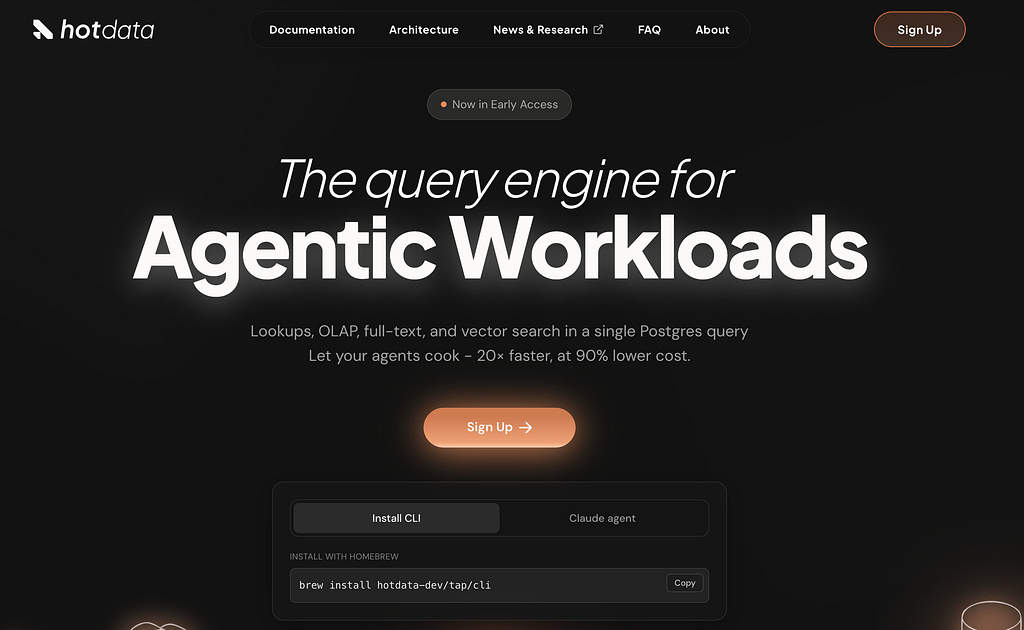
Hotdata comes from understanding that agents have different needs and priorities when accessing data. Agents and AI apps operate on small, dynamic slices of data where latency, context, and composability matter more than raw throughput.
Our goal is have agents access any data source, including databases, lakes, or SaaS systems, through a unified interface that prioritizes latency. Agents should work with data without having to worry about data movement. Every result should be materialized and easily re-accessible. Intermediate results should be reused as part of the workflow instead of being rebuilt each time. Isolation and replayability should live within the data layer itself, making it easy to manage and reason about complex flows.
Hotdata is built around these key principles to build a fundamentally new kind of query engine for agents.
Originally published on Medium.