
FinTech
Spend, credit, and market data in one query
Join transactions, payments, and market data across every source in milliseconds, without touching production.
Your sources
Operational database
Payment processor
Data lake
Your VPC
Hotdata
- Cross-source joins
- Forks
- Audit trail
Used by
Analysts
Risk models
Internal apps
Common workloads
- Spend and expense analytics
- Roll up card and expense activity by company, team, and category, and flag spend that breaks policy.
- Credit decisions
- Pull an applicant's full history in one query, so decisions come fast.
- 9×Faster than ClickHouse, on the same hardware
- Research on market data
- Run many research queries over years of market data at once, with no one waiting.
- 5×Faster than Snowflake, with 10 concurrent clients
- Collections and payables
- Track what each customer owes and has paid, including installments, and what each partner is owed.
- Reconciliation and reporting
- Match records against processor and bank data, and flag the ones that disagree.
- 16×Bigger Snowflake warehouse, still slower than Hotdata →
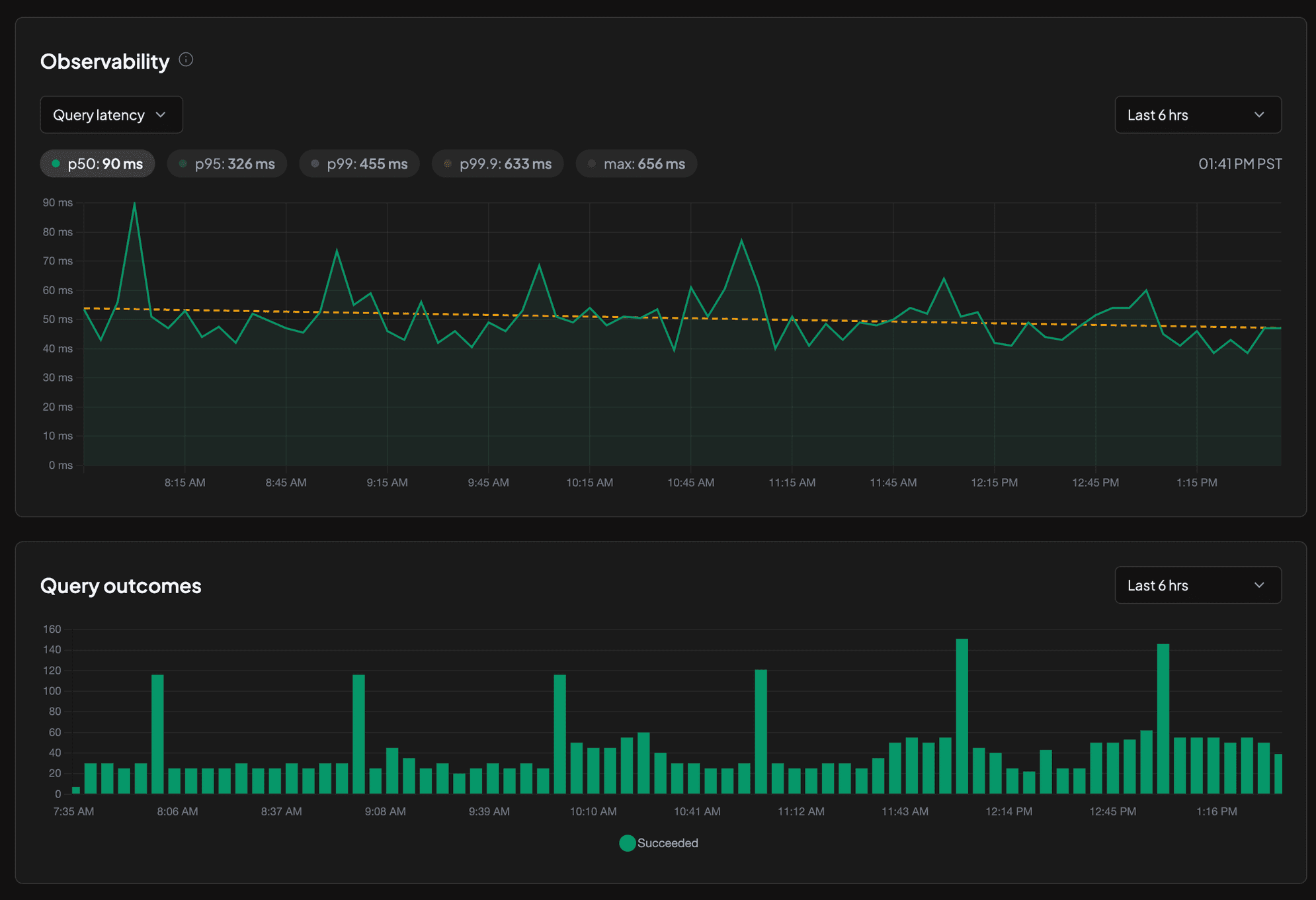
Built-in observability
See how your queries perform, right in the Hotdata console. Nothing extra to set up.
Deployed in your VPC
We deploy Hotdata into your own VPC and operate it for you. If you would rather not run any infrastructure, a fully managed option is also available.
- Security
- Your data stays in your own cloud account. You keep control of the infrastructure, access, and keys.
- Performance
- Hotdata runs in the same network as your databases and object storage, so reads stay inside your cloud.
How Hotdata fits
Many queries at once
With 10 concurrent clients, Hotdata runs 5× faster than Snowflake.
One SQL surface across sources
Join operational databases, payment processors, and lake tables in one query, written in PostgreSQL, DuckDB, Snowflake, or ClickHouse SQL.
HotSQL →Production stays untouched
Read-only access to production, isolated environments, and a full audit trail.
Forks for reproducible work
Fork a database before a close or a research run, so every result traces back to its data.
Forking a database →Corrections without full reloads
Upserts, updates, and deletes apply refunds and status changes without a full reload.
Load modes →Control over heavy queries
Run long queries in the background and reuse stored results.
Query runs →